Seed Flask Quality - Lets Define It
Growing plants is fun and rewarding, largely because each individual plant brings its own personality into your grow space. The diversity within a grex is often the most exciting part of breeding—and having a wide selection of seedlings can easily send you down the next road toward new breeding goals.
But when we talk about flasking—about in-vitro culture, especially for seed-grown plants—we start to see a kind of cognitive dissonance. We want individuality and variation from a seed crop… yet we want the flask to look perfectly uniform: identical size, identical vigor, tidy, even, and “ready to go.” We want difference everywhere except in the one place we’re starting at: the flask itself.
I wish it worked that way. Let’s get into this a bit.
What Is a “Well-Grown” Flask?
For me, it’s pretty simple:
Healthy foliage—green leaves, no excessive etiolation, and nothing obviously dying (unless the species normally goes dormant).
No contamination. (Some late-stage contamination isn’t necessarily a deal-breaker.)
Something I can grow in my own greenhouse without heroic intervention. That usually means roots, maybe pseudobulbs, and seedlings that don’t melt into goo a few days after deflasking.
Seedlings that separate easily. Roots shouldn’t be fused so tightly that I’m forced to compot or tear them apart. (Nice to have, but not always realistic with things like Cattleyas or Paphs.)
Proper shipping. Packed securely, no tumbling, no materials that rot, and temperatures kept within reason.
Notice what’s not in this list: size.
Size is indirectly related to these things, but it’s not a criterion by itself as long as the flask is healthy, viable, and stable.
“But Ben, don’t you expect the plants to be big and robust?”
Sure—within reason. And this is where expectations tend to break hearts or make people fall in love with a particular lab… when they might really just be falling in love (or hate) with the morphology of the first cross that came back.
Size isn’t something a lab can fully control unless you expect them to pour unlimited time and resources into every single cross. Commercial flasking doesn’t allow for that.
And there’s a bit of mythology around this topic—mythology we run into often. Let’s talk about it.
1) How Mericlones Warp Expectations
Growers who work heavily with mericlones often develop expectations that are impossible for seed flasks. Why?
Because mericlones come from proven, extremely vigorous plants—and they grow in near-perfect uniformity. They’re genetically identical; they behave identically; they look identical. Of course the flasks look immaculate.
But seed-grown plants? That’s the whole point: individuality.
Let’s compare:
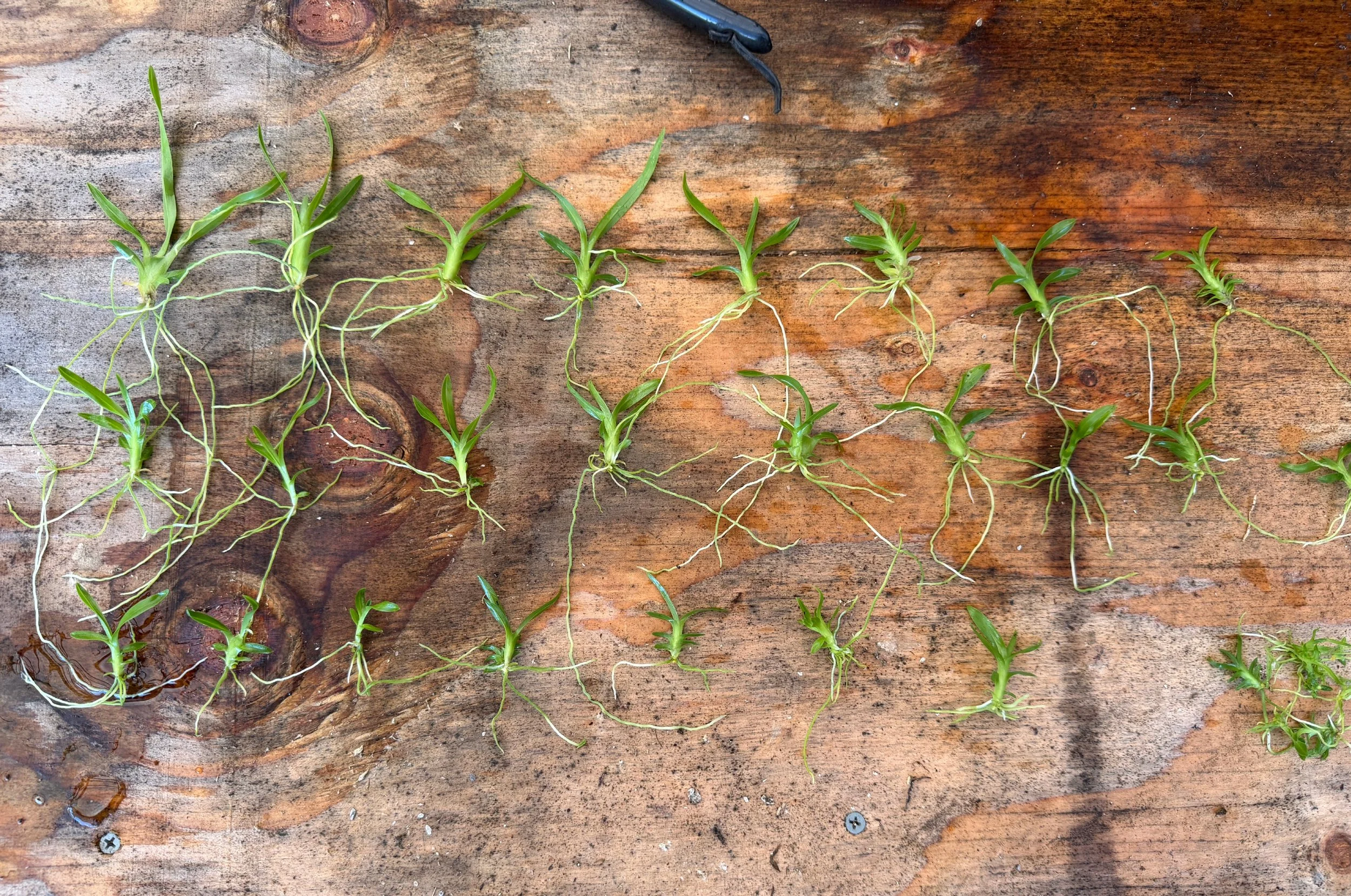
An Oncidiinae cross, de-flasked and plants ordered to show the clear variation in size. Note the little stragglers off to the bottom right.
Seedlings can come from parents that weren’t genetically similar enough to guarantee vigor.
You can get weak growers, mutants, or plants that simply fail to thrive—through no fault of the lab.
Even when a cross is viable, the resulting seedlings will differ in size, habit, and vigor.
You’ll get big ones, small ones, and everything in between—and often, that variation is the goal of breeding.
Selecting only the largest seedlings works against the idea of improving or miniaturizing traits across generations.
2) Labs Can Only Know So Much About Your Cross
Sometimes we get parent info—usually we don’t—but even that doesn’t help much if we’ve never seen the cross before. Labs need to be generalists:
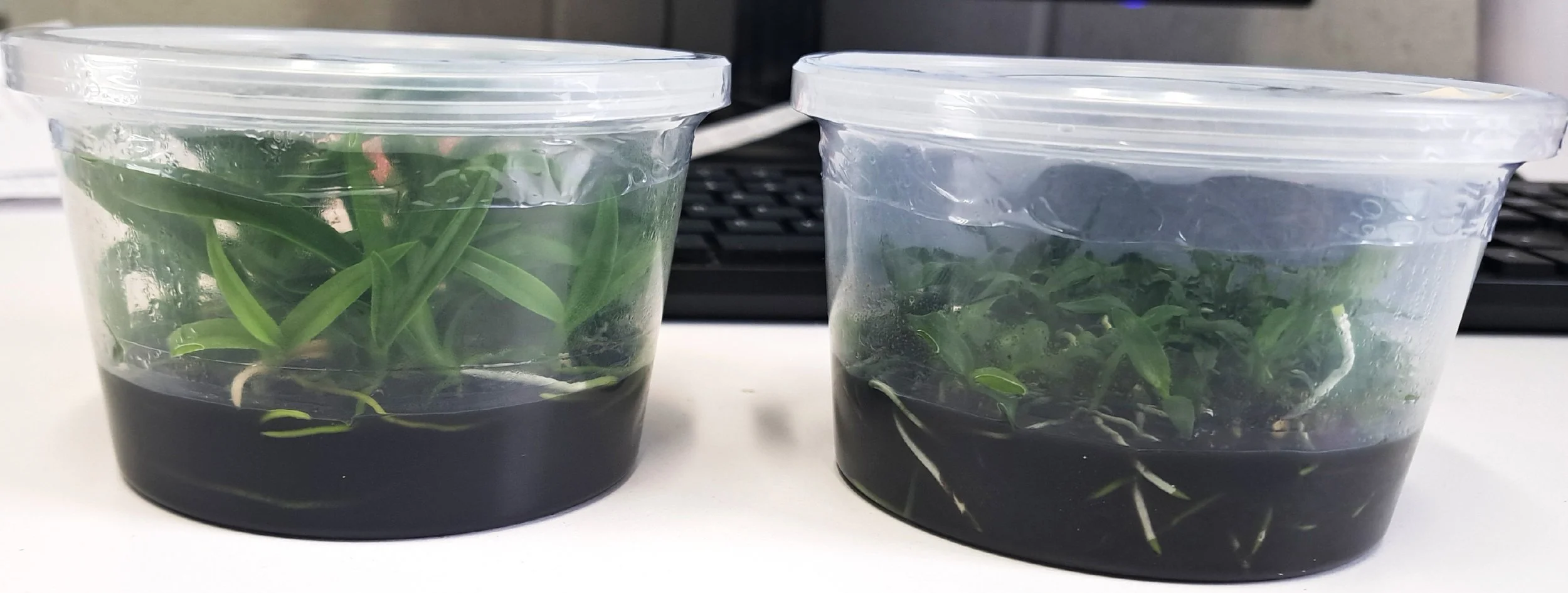
A comparison of two flasks from two different dendrobium grexes both plated around the same time. Sometimes all we know is they are “Dendrobium”, we do not know the expected size of either plant.
Does this genus prefer heavy nutrition or very lean media? (What happens in intergenerics with a little of both?)
What hormone mix helps these seeds germinate?
How hard can we push nutrition early before it becomes detrimental later?
The lab makes decisions that determine the outcome 6–8 months down the road—long before we know whether they were the right decisions. And when we don’t know what size to expect, sometimes we don’t know how to gauge whether a decision was good or bad.
And you, the purchaser, inherit the consequences of those decisions.
Too much nutrition?
You may see stalling, deformities, or even death.
Too little?
Once the media is depleted (again, usually 6–8 months after plating), we have to either:
ship the flask,
replate the seedlings, or
let the plants stall temporarily until nutrition is refreshed.
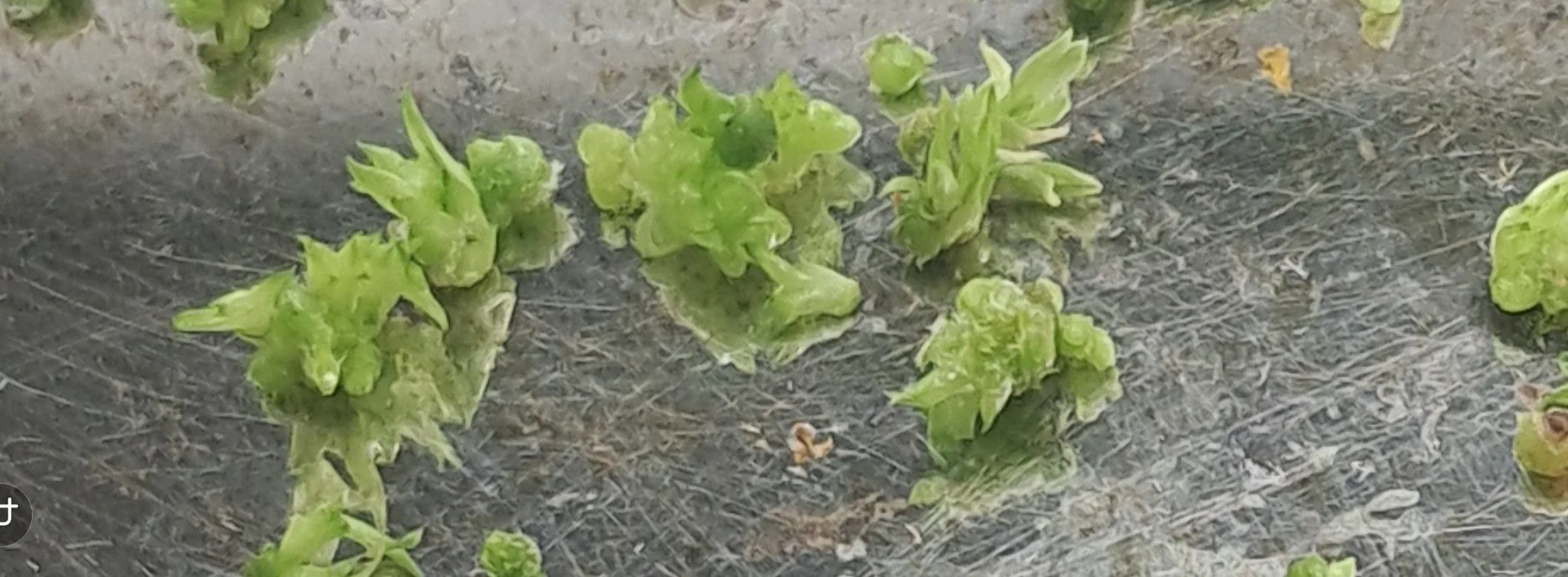
Protocorms proliferating. These issues are hard to diagnose, with causes ranging from improper nutrition, stress, genetic predisposition to growing this way. Plants with this trait can take well over a year and multiple replates to work through this habit, and even longer across multiple encounters with similar crosses to understand and clearly diagnose the underlying cause.
This is why experience matters. A newer lab like ours is constantly learning—but learning requires two cycles:
One 6–8 month cycle to realize what went wrong.
Another 6–8 month cycle to test the adjustment.
That’s a year and a half per improvement on a timeline that is already quite long. And that improvement may only work to partially solve the problem, or create problems elsewhere.
3) The Myth That “This Genus Only Takes X Months”
“It should only take 9 months for Maudiae Paphs!”
“But The Roots did it in that timeframe!”
Sure—an experienced commercial lab with 20 years of specialized work might have protocols dialed in down to the sub-genera. For example, they may know that parvis need X and bulldogs need Y, and they’ll have media designed to squeeze every ounce of growth out of those first 9 months.
But even then, expecting every plant in every cross to be uniformly large in 9 months is unrealistic.
For an order of 750 seedlings, you’ll get a bell curve:
some large, some small, and most in the middle.
A lab with only 1–2 complete cycles under its belt (like us) will have mixed results—some exceptional, some clearly needing refinement. And those refinements take years, not months.
Media formulas are closely guarded secrets. They’re not on the internet, and you won’t get them from your favorite AI platform. You get a starting point, and you build experience from there.
Anyone claiming they can mass-produce Maudiae Paphs in 9 months should have a decade-long track record and photos showing the full range of sizes at the end of that cycle.
4) “Can’t You Just Add More Light?”
Better light improves morphology and reduces etiolation. But it does not significantly affect the ultimate size a plant can reach in vitro.
Inside a flask, seedlings are starved for CO₂. Photosynthesis is almost useless. Growth depends almost entirely on:
available sugars
available nutrients
available water in the media
Light fine-tunes appearance and survivability. It doesn’t create biomass in vitro.
So How Do You Know If a Lab Knows What It’s Doing?
We understand the investment involved in breeding orchids:
A year for the pod
A year for the lab
Another 2–3 years to bloom (for faster genera!)
That’s a five-year commitment. And nobody can shortcut it—the plants grow on their own schedule.
Some labs will do better with certain genera than others, and we always encourage growers to send material to multiple labs to see where each performs best.
But here’s the honest truth about what a seed lab can provide:
Germination of your seed
Growth of 80%+ of seedlings to a viable size
What a lab cannot be:
A storage solution because you’re out of space
A nursery producing 2”-pot-ready seedlings inside a sealed flask on a defined timeline
A business who can disregard economics and cost control.
A miracle worker who turns genetically weak seedlings into vigorous ones
If you want seedlings that separate easily into plug trays and get growing, you’re going to want them before they reach a size that exhausts the media.
Our lab has experience with this—we’ve handled over 1,000 seed pods from across almost all orchid families. We believe we now have expertise beyond almost any single-bedroom laboratory, and comparable to any commercial lab in the U.S.
We won’t get it right every time—and any lab that claims they will is selling a fantasy. But we do learn from the plants, we do make adjustments, and those improvements benefit growers who have patience.
We encourage the use of multiple labs, but clear and realistic expectations should be discussed with every lab you work with before sending material.
Thanks for reading this post—I hope it demystifies lab work a bit and presents a realistic set of expectations for what any seed lab can (and cannot) deliver.
