Why We Built Our Own Lab Software
If you ever visit our lab, one of the first things you will notice is the sheer number of plants. We’ve made over 12,000 flasks, which is going to translate to 300,000+ plants.
At any given time, we typically have more than 2,000 flasks on shelves throughout the laboratory. That may seem manageable. But once you start thinking about the number of different crosses, the need to know who owns what, you quickly realize how important documentation and tracking become.
Young orchids can look nearly identical in flask. A mislabeled bottle can easily be mistaken for another. Handwritten labels can become difficult to read. Alcohol used during routine sterilization can smear ink. A label can fall off. A note written months ago can be forgotten.
Before we even started customer work, we realized that spreadsheets, notebooks, and handwritten labels were not going to be sufficient to handle any scale for external clients looking for a lab. We needed an excellent way to track material, understand our business, save time and reduce mistakes.
So we built our own software.
Ownership and Traceability
The most important question in a tissue culture lab is basic:
Whose plants are these?
Every flask in our lab belongs to a customer or to one of our own breeding projects. We wanted a system that could instantly answer questions like:
Who owns this material?
When was it received?
What genus is it?
How many flasks have been created?
What activities have been performed on it?
Where is that material currently located?
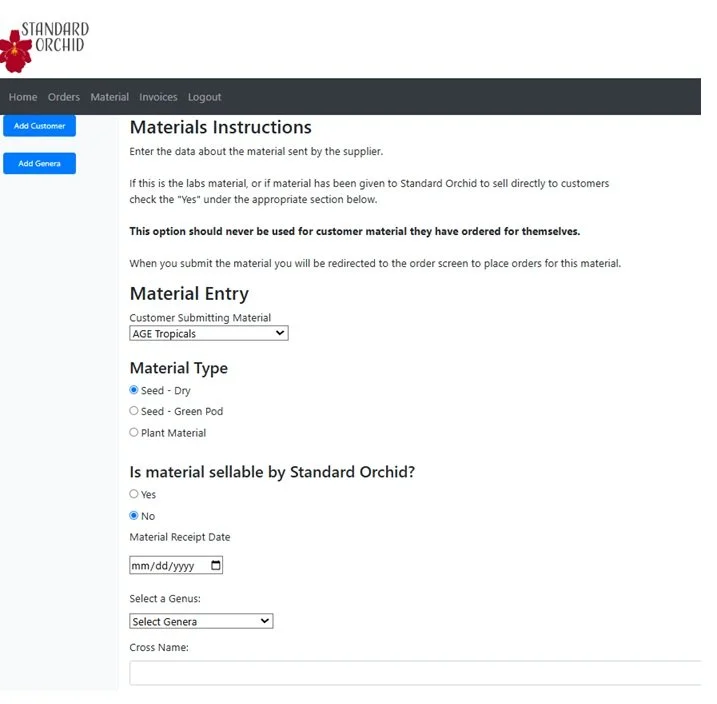
Material Intake
Material is documented as it arrives, tagged with the customer submitting it and if they allow you to sell this material.
You add the genera of the material, and optionally a cross name. Below (not shown) you can enter a unique tracking code or have the system assign you one.
Instead of relying on memory or searching through spreadsheets, scouring different shelves in the lab, every bit of plant material is linked to its complete history, including the various flask generations created from it.
Because when you're managing thousands of bottles, guessing is not an acceptable process.
Reducing Manual Work and Preventing Mistakes
A large portion of laboratory work isn't actually laboratory work. The tasks include:
Paperwork.
Writing labels.
Recording transfers.
Tracking contamination.
Updating spreadsheets.
Creating invoices.
Preparing shipping manifests.
Entering the same information multiple times.
Back & forth with customers on an order.
Every manual process introduces opportunities for mistakes.
We designed our system around barcode scanning and workflow automation wherever possible. Instead of repeatedly writing information down and re-entering it later, data is captured as part of the normal workflow.
Also, When a lab contains thousands of flasks, simply finding material can become a significant time sink. Our software allows us to use barcodes on each label to track the room, rack, shelf for each flask so material can be found immediately rather than spending time searching through rows of nearly identical bottles.
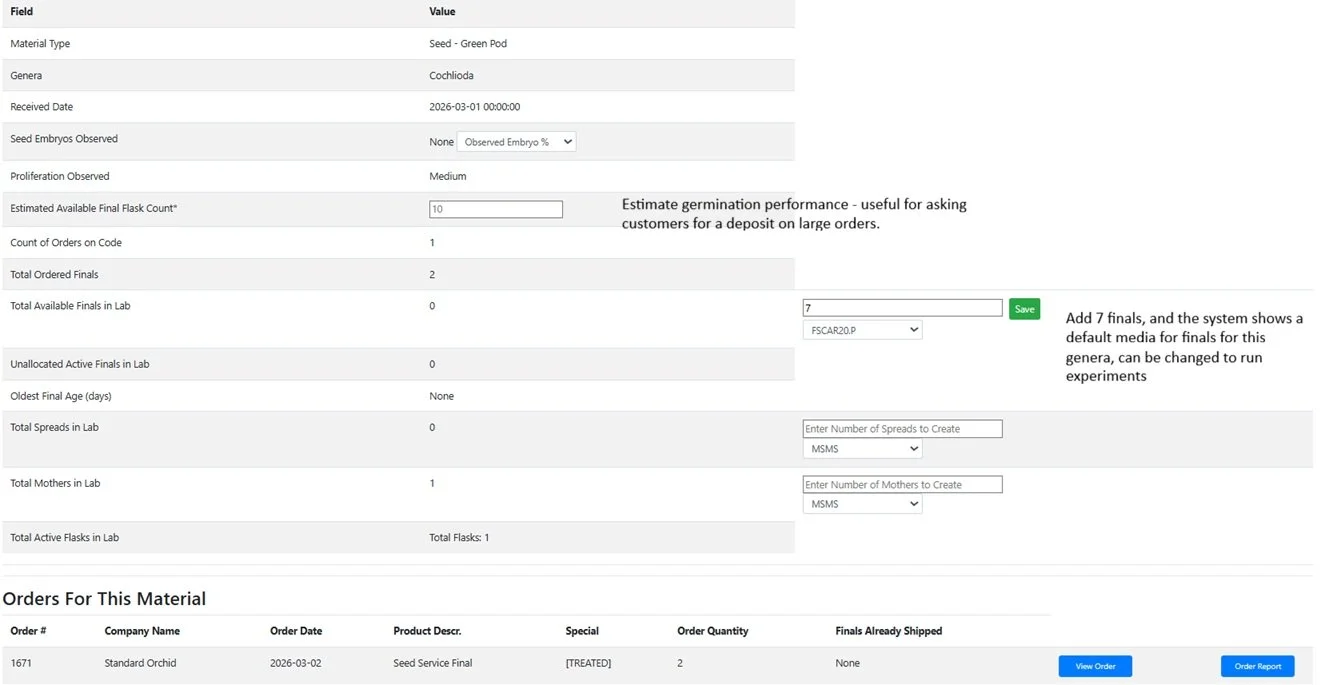
Material maintenance screen - used to perform tasks like estimating germination on an order, logging observations about the seed quality, documenting the creation of mothers / spreads / finals and the corresponding labels.
The result is less administrative work, fewer errors, and more time spent focusing on the plants themselves.
Customer and Material Performance Trends
One of our biggest goals was to better understand our operation.
Every lab develops theories over time:
Does this media perform better for certain genera?
Is material from certain customers more prone to contamination? (and why!?)
Which genera do our customers germinate most successfully?
How long does a typical flask of this genera take to mature? Can we optimize media for it?
Which projects are worth expanding?
Which projects consume significant labor without producing strong results?
Without data, these questions are difficult to answer objectively.
By tracking contamination events, germination rates, media formulations, maturation timelines, locations, and other key metrics, we can evaluate what is actually happening inside the lab.
This allows us to run experiments, compare outcomes, and continuously improve our processes based on evidence rather than assumptions.
Keeping Knowledge From Disappearing
Another challenge we wanted to solve was the management of sharing information between Robert & myself. We don’t always tell each other everything we did, or get the same emails.
Information would have been scattered across notebooks, email threads, online folders or spreadsheets that only one person understands or can access.
Sometimes it's information remembered only by the person who performed the work.
We wanted a centralized system where information could live permanently.
If we make an unusual decision on a project today, we want to be able to understand that decision ten months from now. If a customer asks about a particular cross, we want the history available immediately.
Having information stored in a shared system creates continuity and prevents valuable knowledge from being lost over time.
Ease of Invoicing & Shipping
We solved a key problem of preparing invoices and creating shipping documentation.
Every customer relationship is different. Keeping track of those differences through email chains or even different spreadsheet & saved agreements eventually becomes difficult.
Some customers are charged per flask for laboratory services. Others purchase Standard Orchid inventory directly. Some projects involve deposits based on estimated germination counts, while others include intake fees or custom pricing agreements. Sometimes we decide what to charge when the product is ordered / pre-ordered, other times when the sale is made.
Rather than manually calculating charges each time, our software stores these agreements alongside the customer's project information. Creating an invoice becomes as simple as scanning the material being shipped or recording a germination estimate for a deposit invoice.
The system automatically calculates charges based on the agreed rates, while still allowing us to make adjustments when needed. If a project did not perform as expected and we want to provide a discount or modify pricing, those changes can be made before finalizing the invoice.
Once finalized, the software automatically generates a shipping manifest from the billed material, ensuring that invoicing and shipping documentation remain synchronized. What was once a time-consuming administrative process can now be completed in minutes while reducing the likelihood of billing or shipping errors.
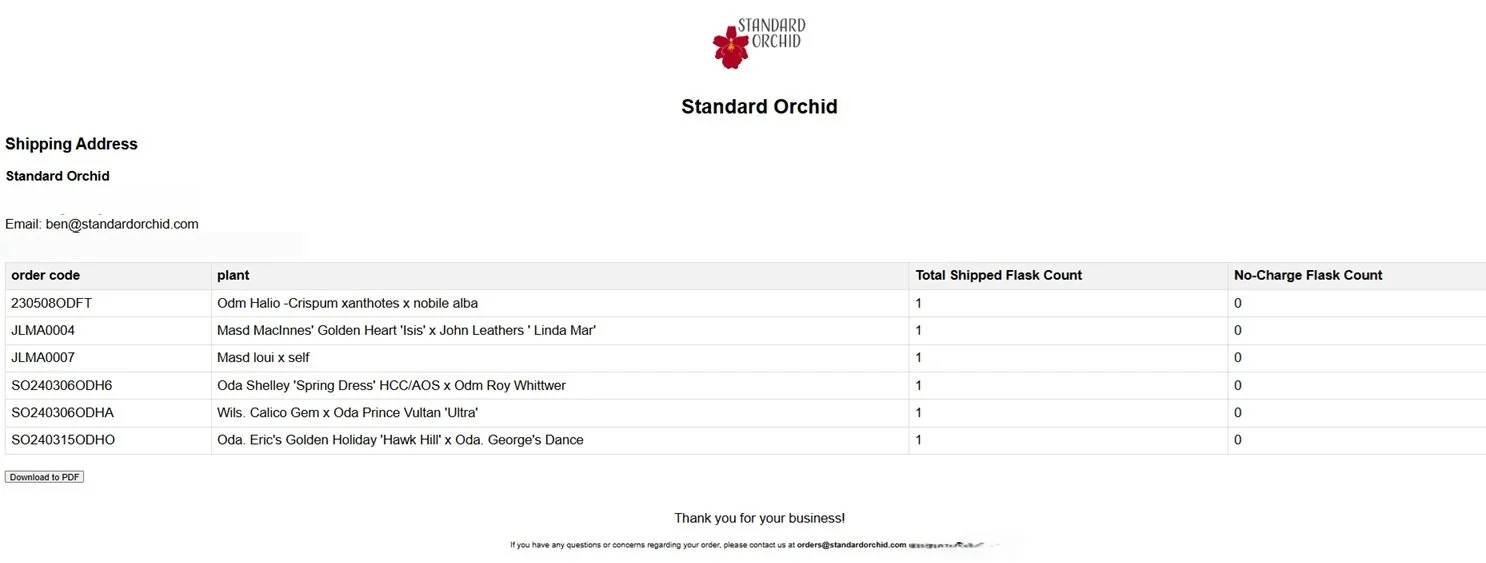
A shipping manifest - automatically generated following the submission of an invoice for those items. In this case, we shipped to ourselves, to mark items out of our lab inventory and grow in our own greenhouse.
Giving Customers Better Visibility
We also anticipated questions from our customers and rather than being a lab who is unresponsive, or too busy to look things up, one feature we wanted to deliver is a customer portal.
Customers can log in and view the status of their projects / material without needing to send emails asking for updates.
They can review activity history, monitor progress, and even view photographs when visual communication is more effective than a written update.
This creates greater transparency and improves communication while reducing administrative overhead for both the lab and the customer.
Built by a Lab, for Labs
We built this system because we needed it, but have taken the extra time to make this software extensible so other labs may utilize it. This intends to be a low cost solution for labs who are looking to add scale, efficiency and reduce manual mistakes.
Every feature exists because it solved a real problem we encountered while operating this laboratory.
Over time, we've realized that many other labs face the same challenges:
Managing thousands of flasks
Tracking customer material
Maintaining accurate records
Understanding performance metrics
Reducing manual data entry
Improving customer communication
What started as an internal tool has evolved into a complete laboratory management platform.
We're continuing to expand its capabilities and are beginning conversations with other laboratories interested in improving traceability, operational efficiency, and customer communication.
If you'd like to learn more about the software or discuss a potential trial, feel free to contact us at ben@standardorchid.com.
